Coastal Succulents


What are they?
The species on this page are closely related to the oraches and goosefoots and are in the family Amaranthaceae, a large assemblage of plants with similarly rather uninspiring, greenish flowers. They have evolved to survive in areas of high salt content and survive such extreme conditions by developing thick outer coatings and by storing water within their cells, resulting in a rather fleshy appearance to the leaves. Beets are leafy members of the same family and are probably most familiar as leaf or root vegetables in various forms. Because beets have been long-cultivated, they exist in a variety of forms which have been selectively bred and therefore can look rather variable. Cultivated forms are often biennial, producing roots and leaves in their first year and flowering in their second year - thus, flowers are not often seen, but sometimes occur on plants that 'bolt' i.e. produce flower and seed in their first year.
Where are they found?
These are generally plants of coastal habitats but cultivated forms of beet may be found in human-influenced habitats such as cultivated fields, roadsides and urban areas.
Identification
This is a small group of species that are fairly easy to tell apart from the general appearance of the flowers and leaves.
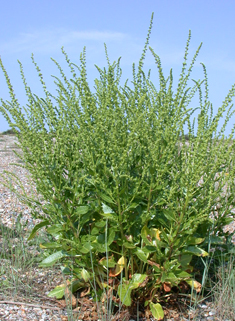
Sea Beet Beta vulgaris ssp. maritima
Native. Very common in coastal habitats throughout the islands. Flowers July to September. The dense clumps of dark, shiny green leaves are distinctive in coastal habitats. The flowers are carried on upright, branched spikes above the foliage.
| |
 |
 |
|
| |
|
|
|
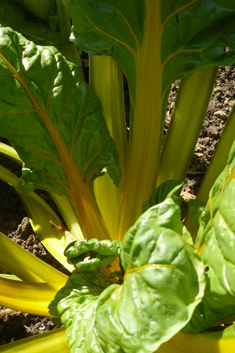
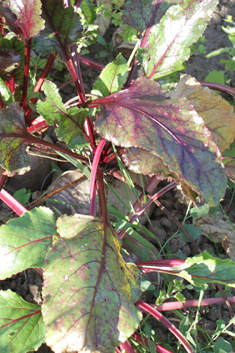
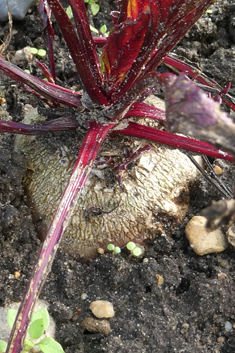
Root Beet Beta vulgaris ssp. vulgaris
Introduced. Grown as a vegetable and occasionally recorded as an escape from cultivation. Flowers July to September. Mostly rather similar to Sea Beet but with much larger leaves and usually a greatly swollen, whitish root. Beetroot, with its rich purple root and leaves is a form of the same species.
| |
 |
 |
 |
| |
|
|
|
 |
 |
 |
|
| |
|
|
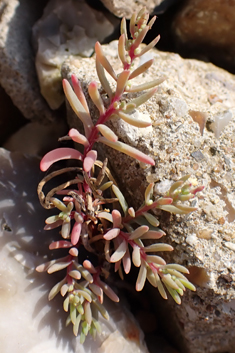
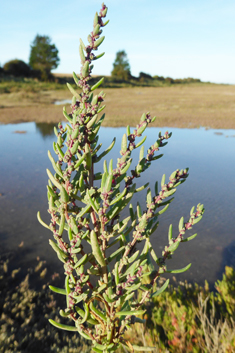
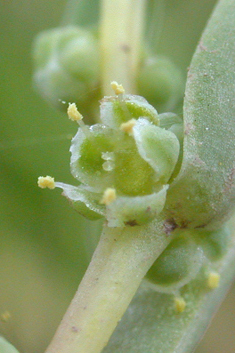
Annual Sea-blite Suaeda maritima
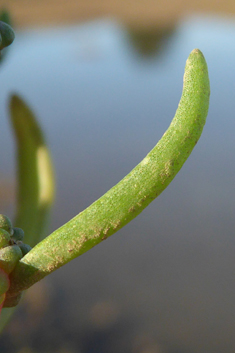
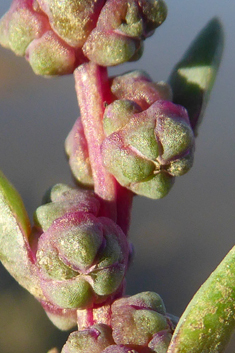
A native plant of intertidal mud and bare areas on saltmarsh. In the absence of suitable habitat, this is a rare plant on Scilly with just a single record from Bryher in 1984. Flowers July to September. A small, annual species, which may form unbranched, upright plants to around 30cm in height, or may also be branched and spreading or sprawling. The petalless flowers are carried in small whorls at the bases of the linear, blunt-tipped, succulent leaves.
 |
 |
 |
 |
| |
|
|
|
 |
 |
||
| |
|
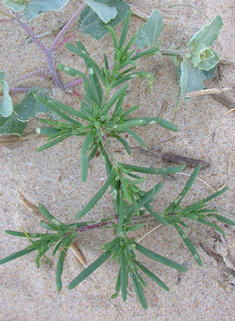
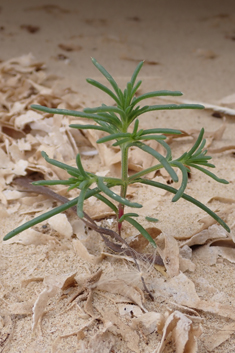
Prickly Saltwort Salsola kali ssp. kali
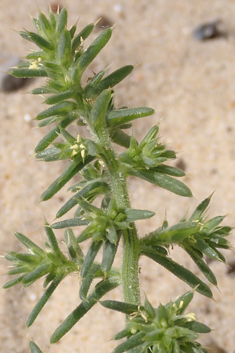
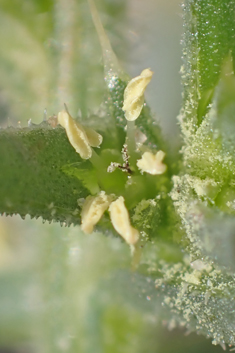
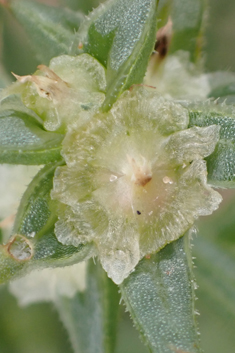
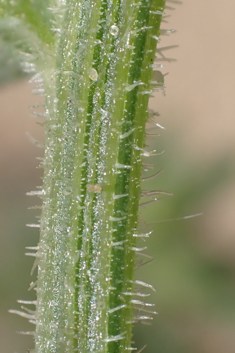
A native plant of coastal sand dunes and sandy beaches, which was once more common but has much declined and there has only been one record in recent years (from Tresco). Flowers July to September. Plants change in appearance as they develop, starting as small, succulent plants with long, spine-tipped leaves and gradually branching to form bushy plants to 45cm or more in height. The leaves tend to fall during the course of the season, leaving the stubbier, spine-tipped bracts towards the tips of the branches. Petalless green flowers are followed by whitish or pink-tinged seed capsules that could be mistaken for flowers.
 |
 |
 |
 |
| |
|
|
|
| |
 |
 |
 |
| |
|
|
|