Bamboos
What are they?
because of cultural associations, bamboos tend to be thought of as plants from China (and perhaps Japan), but in fact, they occur throughout most of the tropical and warm temperate regions of the world (though it's perhaps worth noting that the great majority of species introduced to the UK do indeed come from that region). The largest species may reach 30m in height, while many can be prolific growers in ideal conditions, with some species said to manage almost a metre of growth in 24hours!! These superlatives are not attained in the UK, however and bamboos are popular plants for the garden. The tough, woody exterior of bamboo stems belies the fact that these are actually grasses and this becomes apparent when the flower, or through closer examination of the stem and leaf structure.
Where are they found?
Bamboos are popular garden plants, but their rapid spread can make them unpopular after a few years and plants often get removed and then quietly dumped in the countryside on roadsides and on rough ground. Some larger clumps on private estates often originate from deliberate plantings to provide pheasant cover.
Identification
Click here for help with some of the terminology used on the grass page. Bamboos differ from other grasses in having leaves with a distinct petiole at the base. The bamboos are remarkably variable in their overall appearance, particularly when it comes to height, colour of stems and details of the leaves, so all of these should be noted. Most bamboos rarely flower in the UK, so identification is achieved using features other than the flowers.
Note: as is often the case with plants popular in horticultural, there are artifical varieties of some species that may not fully match the descriptions of their parent species. This is particularly the case in varieties with variegated leaves or different-coloured stems. This page covers the species within East Anglia that are included in the county atlases and/or which I have found in a naturalised context, but bamboos have had periods of popularity since publications of the atlases and there may well be others out which are not included here.
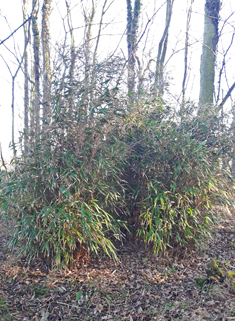
Arrow Bamboo Pseudosasa japonica
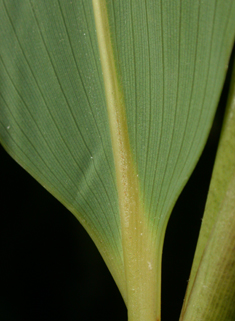
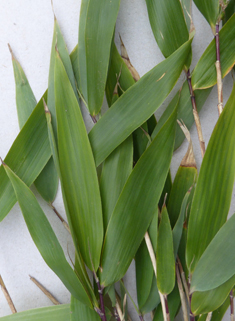
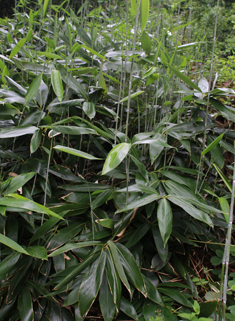
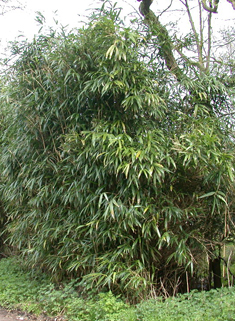
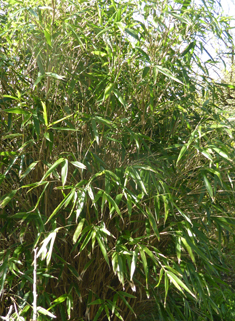
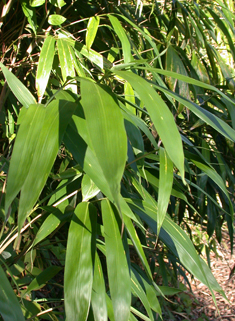
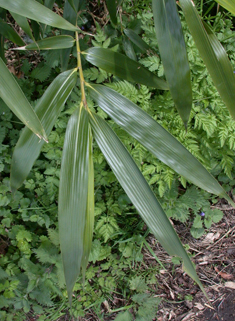
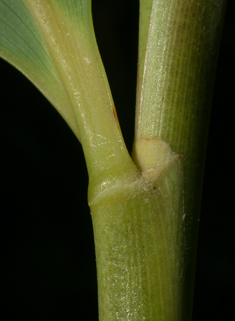
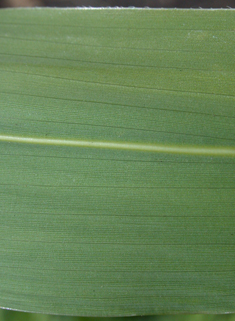
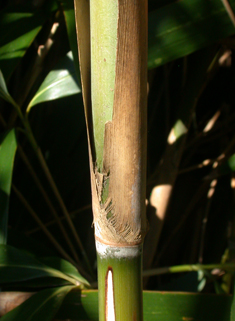
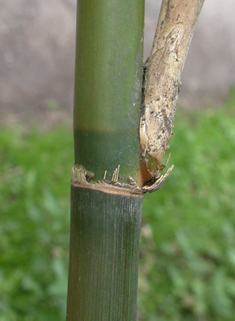
Introduced from eastern Asia as a garden ornamental and persisting at a few sites on St Mary's. Clump forming with stems 2-5m in height. Stems rounded, not strongly flattened on one side, green and often with a slight waxy bloom just below the nodes. Nodes on mid-section of main stems with 1-2 lateral branches. Leaves hairless except along the margins, more than 6x as long as wide, 15-30cm long, 2-4cm wide, with 5-9 veins either side of the midrib.
 |
 |
 |
 |
| |
|
|
|
 |
 |
 |
 |
| |
|
|
|